
-no spoiler alert necessary-
'I suppose that since most of our hurts come through relationships so will our healing, and I know that grace rarely makes sense for those looking in from the outside' (11)
'Relationships are never about power, and the one way to avoid the will to power is to choose to limit oneself - to serve' (106)
'Rights are where survivors go, so they don't have to work out relationships' (137)
'Submission is not about authority and it is not obedience, it is all about relationships of love and respect' (145)
'Being my follower is not trying to "be like Jesus", it means for your independence to be killed' (149)
'So many believe that it is love that grows, but it is the knowing that grows and love simply expands to contain it. Love is just the skin of knowing' (155)
'Each choice ripples out through time and relationships, bouncing off other choices. And out of what seems to be a huge mess, Papa weaves a magnificent tapestry' (176)
'Guilt'll never help you find freedom in me. The best it can do is make you try harder and conform to some ethic on the outside. I'm about the inside' (187)
'Responsibilities and expectations are the basis of guilt and shame and judgment, and they provide the essential framework that promotes performance as the basis for identity and value' (206)
'You love each person differently because of who they are and the uniqueness they draw out of you. And the more you know another, the richer the colors of that relationship' (213)
'Forgiveness is not about forgetting...it's about letting go of another person's throat' (204)
Sunday, October 11, 2009

Thursday, October 8, 2009
Chronogeography
A couple weeks ago I wrote a paper on medieval cartography.
It's more exciting than it sounds, believe me.
On medieval maps, time and space were portrayed as interconnected: the here and now, the there and then, etc. Past, present, and future, too, were all interrelated and intertwined.
It really is a beautiful view of time, and one that I think we'd do well to incorporate more into our everyday thinking.
Because I'm not really sure we're built for the here/now. In our worries we attempt to exercise control over the future. We revisit the past and think of what could have been, over and over, though we know we're chipping at a stone that cannot be broken.
I think part of it might stem from a type of inferiority complex - we love fighting with eternity because it makes us feel the slightest bit more infinite.
But i think our preoccupation with the future/past (the 'there') denotes an intense detachment from the here/now. In thinking of what we could have done or will do better or differently, we ignore the present and forget that the only things that give us some amount of control over the future are our choices here and now. We try to get there without starting here.
And the problem is that it's really hard for us just to be - in the here and now. The present is, to borrow a term from Derrida that I don't actually understand all that well, 'always/already.' We view the present in retrospect, and in that sense the present for us is ephemeral. I think this 'impossibility' of attaining the present spurs us to live in the past and the future, because it's easier that way.
But I don't actually think it's impossible to live in the present, it just requires giving up our false sense of control.
When God said 'I am', it meant that he dwells in the ever-present. We were and will be but God is.
That, to me, signals that the only way we'll really ever be is in God, because our 'human condition' by itself doesn't really allow that.
Something Paul Young wrote inThe Shack (which I finally read this weekend) explains it much better:
And if I look back in my life, I see that the times I've really felt present, really felt here, are when I gave up my regrets about the past and my false sense of control over the future and simply trusted.
Because in reality, that's all we have the power to do.
It's more exciting than it sounds, believe me.
On medieval maps, time and space were portrayed as interconnected: the here and now, the there and then, etc. Past, present, and future, too, were all interrelated and intertwined.
It really is a beautiful view of time, and one that I think we'd do well to incorporate more into our everyday thinking.
Because I'm not really sure we're built for the here/now. In our worries we attempt to exercise control over the future. We revisit the past and think of what could have been, over and over, though we know we're chipping at a stone that cannot be broken.
I think part of it might stem from a type of inferiority complex - we love fighting with eternity because it makes us feel the slightest bit more infinite.
But i think our preoccupation with the future/past (the 'there') denotes an intense detachment from the here/now. In thinking of what we could have done or will do better or differently, we ignore the present and forget that the only things that give us some amount of control over the future are our choices here and now. We try to get there without starting here.
And the problem is that it's really hard for us just to be - in the here and now. The present is, to borrow a term from Derrida that I don't actually understand all that well, 'always/already.' We view the present in retrospect, and in that sense the present for us is ephemeral. I think this 'impossibility' of attaining the present spurs us to live in the past and the future, because it's easier that way.
But I don't actually think it's impossible to live in the present, it just requires giving up our false sense of control.
When God said 'I am', it meant that he dwells in the ever-present. We were and will be but God is.
That, to me, signals that the only way we'll really ever be is in God, because our 'human condition' by itself doesn't really allow that.
Something Paul Young wrote in
'When I dwell with you, I do so in the present - I live in the present. Not the past, although much can be remembered and learned by looking back, but only for a visit, not an extended stay. And for sure, I do not dwell in the future you visualize or imagine...do you realize that your imagination of the future, which is almost always dictated by fear of some kind, rarely, if ever, pictures me there with you?' (142)He goes on to flesh out what our preoccupations mean in respect to how we view God,
'The person who lives by their fears will not find freedom in my love...To the degree that those fears have a place in your life, you neither believe that I am good nor know deep in your heart that I love you' (142)Our detachment from the present is thus a detachment from God.
And if I look back in my life, I see that the times I've really felt present, really felt here, are when I gave up my regrets about the past and my false sense of control over the future and simply trusted.
Because in reality, that's all we have the power to do.
Saturday, September 26, 2009
The Great Isis
Here in Oxford they call the Thames 'Isis'.
Today, I rode my bike alongside the gentle giant and basked in the sunlight and the respite from reading.
I wore my biking hat, I processed, I got grease on my leg, I took some pictures (obvi), I got some sun, and I breathed the crisp air that comes on the cusp of fall (alliteration).
Definitely a good choice. Cheers to the British autumn.

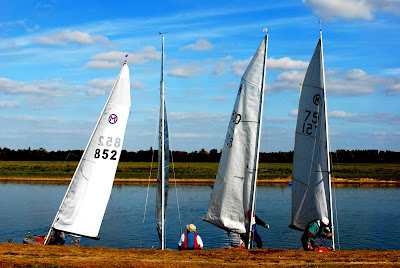


(I didn't mean to look like a pompous philosopher in this picture)


(the dot is my house; I went south first)
View Thames Bike Ride in a larger map
Today, I rode my bike alongside the gentle giant and basked in the sunlight and the respite from reading.
I wore my biking hat, I processed, I got grease on my leg, I took some pictures (obvi), I got some sun, and I breathed the crisp air that comes on the cusp of fall (alliteration).
Definitely a good choice. Cheers to the British autumn.


(I didn't mean to look like a pompous philosopher in this picture)


(the dot is my house; I went south first)
View Thames Bike Ride in a larger map
Friday, September 25, 2009
Tourism // Travel.
I always seem to end up in tourist towns.
Three so far: Paris, Oxford, and to a lesser extent Seattle (not too many tourists flocking in droves to see the coypu at the canal).
But, since I'm always in transition when I visit these cities, I end up in this weird space somewhere between local and tourist.
In Oxford I feel like a local whenever I ride my bike. In Oxford I feel like a tourist whenever I take my camera out of my backpack or open my mouth.
But I think the difference between living in Paris and living in Oxford is that in Paris I lived and shared and conversed with locals or ex-pats. Here I live with American students, have met probably five British people and only somewhat know one.
So despite the bike, I feel much more like a tourist here at Oxford (even my legit Oxford student card says "Visiting Student" on it...just as a reminder).
That brings me, however, to what I really wanted to talk about. The difference between tourism and travel.
With this large group of Americans, I've gone on 3 "field trips" so far that usually consist of sitting on a bus, getting off the bus, listening to someone talk, take pictures, get back on the bus. Although our program ostensibly "doesn't want us to be tourists" and tries instead to make us "informed" by just lecturing us the day before on what we're about to see, I just can't help but feel like an alien when I exit the bus with 60 rowdy Americans with backpacks, cameras, and University of Oxford sweatshirts.
So I wonder, is there a difference between traveling and tourism. Is it just the large group? Would I be any less of a tourist if I went to see Stonehenge alone?
Probably not...I think the group just tends to magnify the ridiculousness of what it is we're forced to do.
As a tourist, you're forced--whether by yourself or your program director--to visit certain parts of the country that make up its "national identity." You get out, you know a bit about what you're looking at, you learn a little bit more, you take some pictures that you could probably have found on a postcard in the United States, and then you leave. Seemingly, the only reason for going is to say that you went.
I find that somewhat disgusting. I also think that's the difference between tourism and travel.
Traveling is about an experience. It's about the journey. It's as much about where you're going as it is about getting there. You can go to National Heritage sites and not be a tourist. I just think it needs to be motivated not by this inane desire to check off another castle or rock formation from your bucket list, but a desire to see the site for itself--not for what it means for your friends back home--and to enjoy it in its totality with whoever you're there with.
And that's why I love visiting cities where I have friends. When I go to a place like London, where I know no one, it seems as if I'm walking around and checking off things from a list. I bet a lot of people in my program would be suprised if they found out I spent two days in London and didn't see the Imperial War Museum, the British Museum, the Tower of London, etc. But for me London wasn't about seeing as many sites as humanly possible in a 48 hour period, but about reconnecting with Alex and Nate over a pint and roaming the streets, wherever they led us.
Being in Paris was similar. I didn't go to walk every square foot of the Louvre, but to reconnect and to walk (or rather, bike) the streets. I know its a bit nuanced since I've done almost every touristical activity in that city, but I think if I went back to my exchange I would relax a bit, and not be so hard on myself for not going to different monuments all the time.
And I think that's what I need to do here. I've been sort of stressed because I've been so busy with writing and researching that I haven't had much time to see the sites that I'm "supposed to see." In addition, I came into the country, Lonely Planet travel guide in hand, expecting to see as much of the country as possible. But both of those things are stifling. I shouldn't feel that I need to see anything. I should probably want to, since I'm here and all, but I'm not going to spend 5 hours a day seeing museums that aren't enjoyable just to say that I've been to them.
So I'm not going to. I'm going to be here, and I'm going to enjoy it. I'm going to work in moderation, relax in moderation, and visit in moderation. And when I leave, I will be content with what I've acheived and seen, knowing that I'm not a tourist, and probably not a traveler, but somewhere in between.
And in a week, I'll be putting all of this into practice as I head off with Nate and Alex to visit Tyler Hargan and his parents in Riga, Latvia.
I'm glad I know people there.
Wednesday, September 23, 2009
Why I'm excited for October 9th
Email from my tutor:
Hugh...you know me too well
Brent,
Do you drink coffee? If so, I will try to organise one for our tutorial. Do you take milk or sugar? Otherwise, see you on the 9th
best wishes, Hugh
Hugh...you know me too well
Sunday, September 13, 2009
One Week
Hypothetical situation: You have one week to live. You have the opportunity to find out the answers to two eternal questions that have been plaguing your mind before you hit the hay.
Which questions would you have answered?
Personally, I'd probably choose these two: "What can maps tell us about the medieval conception of time?" and "Was Oxford a typical medieval university?"
Incidentally, it's quite lucky that I will have the answers to these two questions by next Monday, and, in addition, will hopefully have more than a week to live. The only downside is that I have to find the answers myself, and I have to write two eight-page papers explaining those answers.
In any case, I know what I'm doing this week, so before I retreat into the dark corners of the Bodleian library, I thought I'd leave you with some pictures from the last week.


Sunday, September 6, 2009


Subscribe to:
Posts (Atom)
